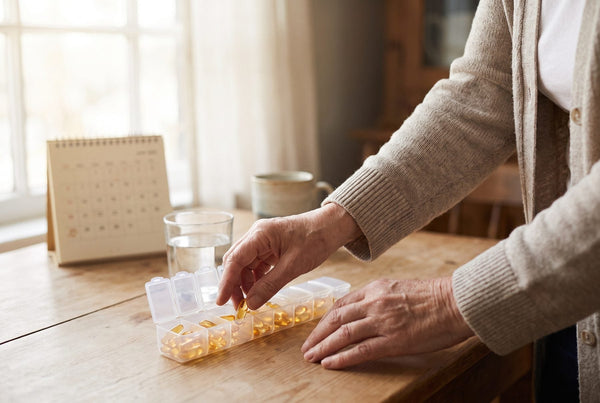
If you take a blood thinner, talk with your doctor or pharmacist before starting an AREDS2 formula. Vitamin E is the main ingredient to discuss: the NIH Office of Dietary Supplements (ODS) says large doses can raise bleeding risk with medicines such as warfarin, probably above 400 IU a day, and AREDS2 contains 400 IU. People on warfarin also need steady vitamin K intake, which matters for combined multivitamin products and leafy greens. The pages we reviewed list no warfarin interaction for zinc, copper, vitamin C or lutein.
If you take a blood thinner and your eye doctor suggests an AREDS2 formula, you may wonder whether it is safe with warfarin or another medicine that prevents clots. The honest answer is that it depends on your medicine, your dose and your health, so your prescriber needs to be part of the decision.
This article pulls together what the National Eye Institute (NEI), ODS and MedlinePlus say, ingredient by ingredient, and ends with questions you can bring to your appointment.

Vitamin E: the main ingredient to discuss
The AREDS2 formula contains 400 IU of vitamin E a day. The ODS vitamin E fact sheet explains the concern: "Vitamin E can inhibit platelet aggregation and antagonize vitamin K-dependent clotting factors." As a result, "taking large doses with anticoagulant or antiplatelet medications, such as warfarin (Coumadin), can increase the risk of bleeding, especially in conjunction with low vitamin K intake."
How large is large? ODS says the amounts needed to cause clinically significant effects "are unknown but probably exceed 400 IU/day." The AREDS2 dose sits right at that level, which is why it deserves a conversation rather than a guess.
NEI's AREDS/AREDS2 FAQ gives the trial side of the picture:
- "The AREDS and AREDS2 trials found no adverse effects of 400 IU/day vitamin E."
- Other studies using more than 1,500 IU a day of natural vitamin E, or 1,100 IU a day of the synthetic form, "observed increased risk of bleeding, including brain bleeds."
- Vitamin E "can interact with some medications, including blood thinners, chemotherapeutic agents, and lipid-lowering drugs," and NEI "recommends consulting with a health care provider before taking vitamin E or other nutritional supplements."
Vitamin K: keep it steady if you take warfarin
The AREDS2 formula as NEI lists it contains no vitamin K. But vitamin K still matters, for two reasons: some combined eye vitamin products include it, and leafy greens, which are rich in lutein, also contain vitamin K.
The ODS vitamin K fact sheet says: "Vitamin K can have a serious and potentially dangerous interaction with anticoagulants such as warfarin (Coumadin)." People taking warfarin "need to maintain a consistent intake of vitamin K from food and supplements because sudden changes in vitamin K intakes can increase or decrease the anticoagulant effect."
MedlinePlus gives practical food guidance for people on warfarin: "Eat consistent amounts of vitamin K-containing food on a week-to-week basis. Do not eat large amounts of leafy, green vegetables or certain vegetable oils that contain large amounts of vitamin K."
- Combined products. PreserVision AREDS 2 Formula + Multivitamin lists vitamin K among its added vitamins. Our article Can you take AREDS2 with a multivitamin? covers combined products.
- Leafy greens. ODS lists 145 mcg of vitamin K in 1 cup of raw spinach and 426 mcg in half a cup of boiled frozen turnip greens. If you read our lists of lutein-rich greens or AREDS2 nutrients from food, check any change in how much you eat with your warfarin care team first.
Fish oil and omega-3s
The AREDS2 formula does not contain omega-3s; AREDS2 tested them and found no added benefit. Some eye vitamins do include them, and fish oil is also sold on its own.
The ODS omega-3 fact sheet says fish oil "can have antiplatelet effects at high doses, although it appears to be less potent than aspirin," and "might prolong clotting times" with warfarin. It adds that most research shows 3 to 6 g a day of fish oil does not significantly affect anticoagulant status, and that the labels of FDA-approved omega-3 drugs say patients on anticoagulants "should be monitored periodically for changes in INR." Our article on omega-3s and your eyes covers the eye research.
Coenzyme Q10 and herbal products
MedlinePlus lists coenzyme Q10, echinacea, garlic, ginkgo biloba, ginseng, goldenseal and St. John's wort among nonprescription or herbal products that may interact with warfarin. It also names aspirin and nonsteroidal anti-inflammatory drugs (NSAIDs) such as ibuprofen or naproxen, along with omeprazole and famotidine. MedlinePlus says: "Do not start any of these medications while taking warfarin without discussing with your healthcare provider."
This matters for eye vitamins because some products add coenzyme Q10. For example, Bausch + Lomb sells a PreserVision AREDS 2 Formula + CoQ10. If you take warfarin, read the full Supplement Facts panel, not just the "AREDS2" on the front.
Zinc, copper, vitamin C and lutein
On the ODS and MedlinePlus pages we reviewed, we found no listed interaction between warfarin or other anticoagulants and zinc, copper, vitamin C, lutein or zeaxanthin. The ODS copper fact sheet says copper "is not known to have any clinically relevant interactions with medications."
No listed interaction is not the same as proven safe for you. Zinc and vitamin C have other interactions and cautions, covered in Are AREDS2 vitamins safe?
Keep in mind: the interaction guidance on the pages we reviewed mostly names warfarin. If you take a different blood thinner, the pages we reviewed do not give specific guidance for your medicine. Ask your doctor or pharmacist. MedlinePlus also notes that people over 65 have a higher chance of bleeding while taking warfarin.
Questions to ask your doctor or pharmacist
- Is the 400 IU of vitamin E in an AREDS2 formula safe with my blood thinner and my dose?
- Does my eye vitamin, or any other supplement I take, contain vitamin K, coenzyme Q10 or fish oil?
- If I start eating more leafy greens for lutein, do my INR checks or my warfarin dose need attention?
- I also take aspirin or a pain reliever such as ibuprofen. Does that change anything?
- Should my INR be checked after I start or stop a supplement?
- Do I actually have the stage of AMD that the AREDS2 formula was studied in?
MedlinePlus advises keeping "a written list of all of the prescription and nonprescription (over-the-counter) medicines, vitamins, minerals, and dietary supplements you are taking." Bring the bottles or labels too, so your pharmacist can read the exact amounts.
Frequently asked questions
Can I take AREDS2 if I am on warfarin?
Only your prescriber can answer that for you. ODS flags vitamin E as a bleeding concern with warfarin at large doses, probably above 400 IU a day, and AREDS2 contains 400 IU. NEI says the AREDS trials found no adverse effects at that dose, but that finding does not tell you how the dose will work with your medicines.
Is vitamin K in my eye vitamin a problem?
For people on warfarin, ODS says the key is a consistent intake of vitamin K from food and supplements, because sudden changes can raise or lower warfarin's effect. Tell your care team before starting or stopping any product that contains vitamin K.
What if I take a blood thinner other than warfarin?
The ODS and MedlinePlus pages we reviewed name warfarin specifically. ODS describes the vitamin E concern for "anticoagulant or antiplatelet medications" in general. We found no source-specific guidance for other medicines, so ask your doctor or pharmacist.
Should I avoid leafy greens?
MedlinePlus does not say to avoid them entirely. It says to eat consistent amounts of vitamin K foods week to week and not to eat large amounts of leafy greens. Your care team can help you find a steady amount that works. Our science page lists the doses used in the AREDS trials.
Related reading
- Are AREDS2 Vitamins Safe? Side Effects and Interactions
- Vitamin C and Vitamin E for Eye Health
- Can You Take AREDS2 With a Multivitamin?
- What Is AREDS2 and Who Needs It?
- AREDS2 Supplements Compared by Label
References
- NIH Office of Dietary Supplements. Vitamin E: fact sheet for health professionals (updated March 26, 2021). ods.od.nih.gov
- NIH Office of Dietary Supplements. Vitamin K: fact sheet for health professionals (updated March 29, 2021). ods.od.nih.gov
- NIH Office of Dietary Supplements. Omega-3 fatty acids: fact sheet for health professionals (updated August 22, 2025). ods.od.nih.gov
- NIH Office of Dietary Supplements. Copper: fact sheet for health professionals (updated October 18, 2022). ods.od.nih.gov
- MedlinePlus. Warfarin (last revised March 15, 2026). medlineplus.gov
- National Eye Institute. AREDS/AREDS2 frequently asked questions (updated November 19, 2020). nei.nih.gov
- National Eye Institute. About AREDS and AREDS2 (updated October 22, 2025). nei.nih.gov
- Bausch + Lomb. PreserVision AREDS 2 Formula + Multivitamin (accessed September 13, 2026). preservision.com
This article is for general education and is not medical advice. Talk with your eye doctor before starting any supplement, especially if you smoke, take other medicines, or have a health condition. These statements have not been evaluated by the Food and Drug Administration. TruVista products are not intended to diagnose, treat, cure, or prevent any disease.