The five nutrients in the AREDS2 eye vitamin formula are vitamin C, vitamin E, zinc, copper, and lutein with zeaxanthin. That is the formula the National Eye Institute (NEI) studied in people with intermediate AMD or late AMD in one eye. Food is the everyday source of all five. The high trial doses are meant for specific stages of age-related macular degeneration (AMD), not for preventing eye disease.
Eye doctors, supplement labels and health websites keep returning to the same short list. This article takes each nutrient in turn: what the NIH Office of Dietary Supplements (ODS) and NEI say about it, what the research shows, which foods provide it, and how much adults over 50 need each day. For the bigger picture, start with our guide to nutrition and eye health.
Two terms appear below. The RDA (Recommended Dietary Allowance) is the daily amount that meets the needs of most healthy adults. The upper limit is the highest daily amount unlikely to cause harm for most adults, unless a doctor advises otherwise.

1. Vitamin C
Its role in the eye research: In AREDS, vitamin C was one of the "antioxidants" in the formula, at 500 mg a day.
What the evidence shows: The ODS vitamin C fact sheet says the evidence does not show that vitamin C, alone or with other antioxidants, affects the risk of developing AMD or cataracts. But people who already have AMD and take antioxidant supplements that include vitamin C have a lower risk of progressing to advanced AMD. A 2017 Cochrane review found vitamin C probably does not prevent AMD (risk ratio 0.96). A risk ratio compares risk in two groups, and 1 means no difference.
For cataracts, ODS notes that high-dose supplements of about 1,000 mg a day were linked to a 25% higher risk of cataract extraction in a cohort of 24,593 Swedish women. That is an observational finding, not proof of harm. The AREDS antioxidant group did not have a lower cataract risk than placebo.
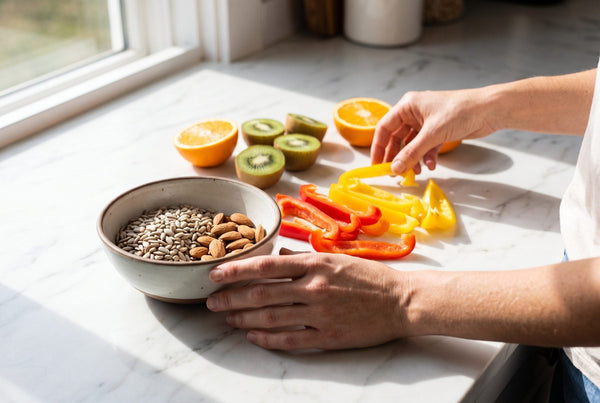
Food sources (ODS): ½ cup raw sweet red pepper (95 mg), ¾ cup orange juice (93 mg), 1 medium orange (70 mg), 1 medium kiwifruit (64 mg).
Daily target: RDA 75 mg for women and 90 mg for men. People who smoke need 35 mg more a day. Upper limit 2,000 mg.
2. Vitamin E
Its role in the eye research: Vitamin E was the other main "antioxidant" vitamin in AREDS and AREDS2, at 400 IU a day. ODS lists that dose as 180 mg of the synthetic form (dl-alpha-tocopheryl acetate).
What the evidence shows: According to the ODS vitamin E fact sheet, cohort studies link higher vitamin E from food (about 20 mg a day) with roughly 20% lower AMD risk, but two trials of vitamin E supplements found no protective effect. The 2017 Cochrane review rated the evidence that vitamin E does not prevent AMD as high certainty (risk ratio 0.97). ODS says the AREDS formulas "hold promise for slowing the progression of AMD in people at high risk of developing advanced AMD," and that AREDS and AREDS2 showed no effect on cataracts.
Food sources (ODS): 1 tablespoon wheat germ oil (20.3 mg), 1 ounce dry roasted sunflower seeds (7.4 mg), 1 ounce dry roasted almonds (6.8 mg), 1 ounce dry roasted hazelnuts (4.3 mg).
Daily target: RDA 15 mg for men and women. Upper limit 1,000 mg from supplements. Labels may list IU instead of mg: 1 IU of the natural form (d-alpha-tocopherol) equals 0.67 mg, and 1 IU of the synthetic form (dl-alpha-tocopherol) equals 0.45 mg.
Keep in mind: ODS notes that large doses of vitamin E may raise bleeding risk in people taking blood thinners such as warfarin, probably at doses above 400 IU a day. If you take a blood thinner, talk with your eye doctor and the doctor who prescribes it before starting.
3. Zinc
Its role in the eye research: Zinc is one of the two minerals in the AREDS formula, at 80 mg a day as zinc oxide.
What the evidence shows: In observational studies, people who get more zinc have a lower AMD risk, according to the ODS zinc fact sheet. In AREDS, NEI reports that zinc plus copper alone lowered progression to advanced AMD by 21%, and the full formula by 25%. AREDS2 found no difference between 25 mg and 80 mg of zinc, but NEI still treats 80 mg as the gold standard because AREDS2 had no placebo group for that comparison. Our article on zinc and copper goes deeper.
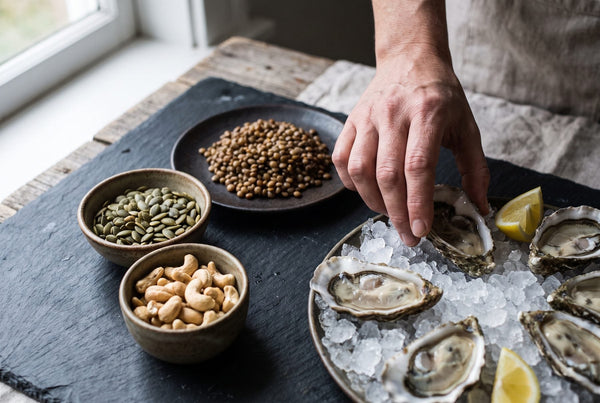
Food sources (ODS): 3 ounces raw farmed Eastern oysters (32 mg), 3 ounces roasted beef bottom sirloin (3.8 mg), 3 ounces cooked blue crab (3.2 mg), 1 cup cooked oats (2.3 mg).
Daily target: RDA 8 mg for women and 11 mg for men. Upper limit 40 mg, which means the AREDS2 dose is twice the limit. ODS says taking 50 mg or more a day for weeks can interfere with copper absorption and lower HDL cholesterol. Zinc can also reduce how much quinolone or tetracycline antibiotic you absorb, so ODS advises taking the antibiotic at least 2 hours before or 4 to 6 hours after zinc.
4. Copper
Its role in the eye research: NEI explains why copper is in the formula: copper (as cupric oxide) was added to reduce the risk of copper deficiency anemia linked to high zinc intake, and NEI says there is no evidence that the 2 mg dose was harmful.
What the evidence shows: The ODS copper fact sheet does not discuss AMD or cataracts. It does explain why copper matters alongside zinc: zinc intakes of about 60 mg a day for up to 10 weeks lowered a marker of copper status, which is one reason the zinc upper limit is 40 mg. ODS lists anemia among the signs of copper deficiency, and says copper has no known clinically relevant interactions with medicines.
Food sources (ODS): 3 ounces pan-fried beef liver (12,400 mcg), 1 ounce unsweetened baking chocolate (938 mcg), 1 medium cooked potato with skin (675 mcg), 1 ounce dry roasted cashews (629 mcg).
Daily target: RDA 900 mcg (0.9 mg) for men and women. Upper limit 10,000 mcg (10 mg).
5. Lutein and zeaxanthin
Their role in the eye: ODS says lutein and zeaxanthin "accumulate in the retina, the tissue in the eye that is damaged by AMD." AREDS2 used 10 mg of lutein and 2 mg of zeaxanthin a day. They replaced the original formula's carotenoid, which was linked to more lung cancers in former smokers. Our article on lutein and zeaxanthin explains more.
What the evidence shows: In the main AREDS2 analysis, adding lutein and zeaxanthin did not further lower risk (hazard ratio 0.90). A hazard ratio compares how quickly an outcome happens in two groups over time, and 1 means no difference. In a secondary analysis reported by ODS, people with the lowest lutein and zeaxanthin in their diets had a 26% lower risk of advanced AMD when they took them. After 10 years, lutein and zeaxanthin were linked to a lower risk of late AMD than no lutein and zeaxanthin (hazard ratio 0.91). The 2017 Cochrane review found no trial evidence on lutein and zeaxanthin for preventing AMD.
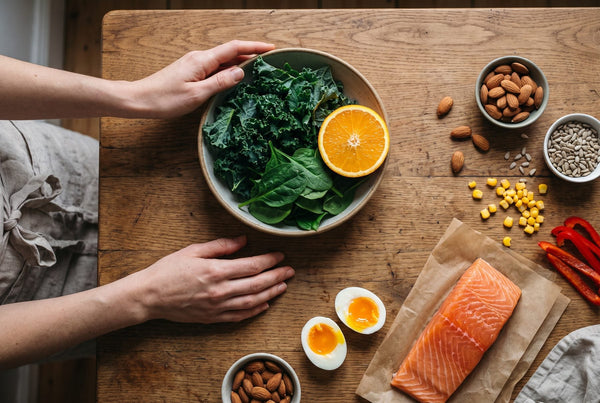
Food sources (USDA FoodData Central): 1 cup boiled spinach (20,300 mcg), 1 cup boiled collards (11,800 mcg), 1 cup boiled kale (5,880 mcg), ½ cup frozen green peas, boiled (1,920 mcg). One large raw egg yolk is listed at about 185 mcg, an estimated rather than measured value. If you take the blood thinner warfarin, MedlinePlus advises keeping the amount of vitamin K foods you eat consistent and not eating large amounts of leafy greens, so check with your doctor before changing your diet.
Daily target: No RDA or upper limit has been set.
What about other nutrients?
In AREDS2, adding omega-3 fatty acids to the formula gave no extra benefit (hazard ratio 0.97). The American Academy of Ophthalmology says there is no clear evidence that adding other vitamins or micronutrients provides extra benefit for AMD. For the safety side of the full formula, see Are AREDS2 vitamins safe?
Frequently asked questions
Should I take these as supplements if my eyes are healthy?
NEI says the AREDS formulas showed no benefit for people without AMD or with early AMD, and that "nutritional supplements cannot prevent AMD." Your eye doctor can tell you whether you have AMD and what stage it is. See Can AREDS2 prevent macular degeneration?
Is a regular multivitamin enough?
Not if the goal is the AREDS2 amounts. NEI says those doses are much higher than a multivitamin provides. You can take both: almost nine in ten AREDS2 participants also took a multivitamin.
Can I get these from food?
Lutein and zeaxanthin, yes, based on USDA food values. NEI says the high levels in the AREDS formulas are hard to reach through diet alone, and ODS food tables show this is especially true for vitamin C, vitamin E and zinc. Our article Can you get AREDS2 nutrients from food? compares the amounts.
If you are comparing formulas, our science page lists the doses used in the trials.
Related reading
- Vitamin C and Vitamin E for Eye Health
- AREDS and AREDS2 Explained
- AREDS2 Supplements Compared by Label
- What Is AREDS2 and Who Needs It?
References
- NIH Office of Dietary Supplements. Vitamin C: Fact Sheet for Health Professionals (updated July 31, 2025). ods.od.nih.gov
- NIH Office of Dietary Supplements. Vitamin E: Fact Sheet for Health Professionals (updated March 26, 2021). ods.od.nih.gov
- NIH Office of Dietary Supplements. Zinc: Fact Sheet for Health Professionals (updated January 6, 2026). ods.od.nih.gov
- NIH Office of Dietary Supplements. Copper: Fact Sheet for Health Professionals (updated October 18, 2022). ods.od.nih.gov
- NIH Office of Dietary Supplements. Vitamin A and Carotenoids: Fact Sheet for Health Professionals (updated March 10, 2025). ods.od.nih.gov
- National Eye Institute. About AREDS and AREDS2; AREDS/AREDS2 Frequently Asked Questions. nei.nih.gov
- Evans JR, Lawrenson JG. Antioxidant vitamin and mineral supplements for preventing age-related macular degeneration. Cochrane Database Syst Rev. 2017;7:CD000253. doi:10.1002/14651858.CD000253.pub4
- AREDS2 Research Group. JAMA. 2013;309:2005. doi:10.1001/jama.2013.4997
- Chew EY, et al. AREDS2 Report No. 28. JAMA Ophthalmol. 2022;140:692. doi:10.1001/jamaophthalmol.2022.1640
- USDA FoodData Central, SR Legacy: spinach (168463), collards (170407), kale (169238), frozen peas (170017), egg yolk (172184). fdc.nal.usda.gov
- MedlinePlus. Warfarin (last revised March 15, 2026). medlineplus.gov
This article is for general education and is not medical advice. Talk with your eye doctor before starting any supplement, especially if you smoke, take other medicines, or have a health condition. These statements have not been evaluated by the Food and Drug Administration. TruVista products are not intended to diagnose, treat, cure, or prevent any disease.