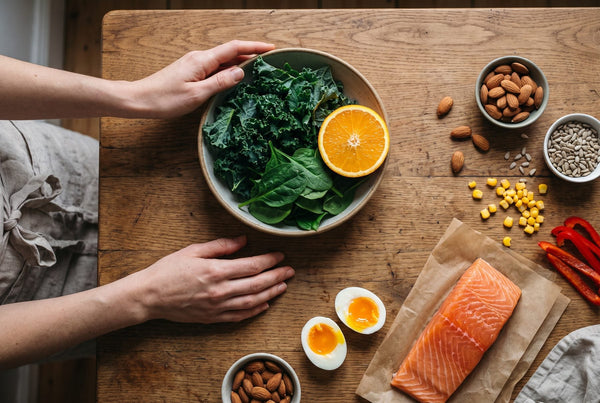
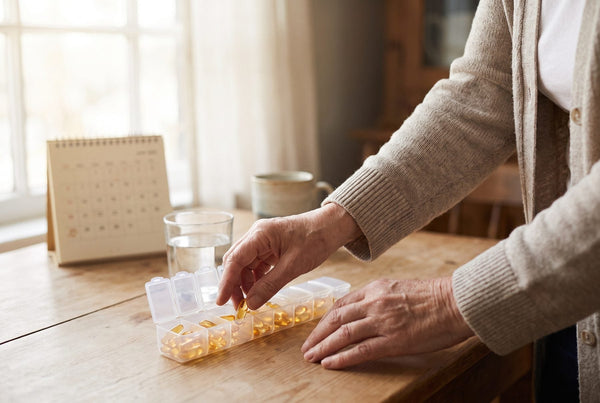
Partly. The lutein and zeaxanthin in AREDS2 (12 mg a day) is a realistic amount to eat: USDA data show about 20 mg in one cup of boiled spinach. The vitamin C, vitamin E and zinc doses are another story, and the National Eye Institute (NEI) says those high levels are difficult to reach from diet alone. Keep in mind that the trial results came from supplements taken by people with intermediate or late AMD, not from food.
Food does matter for your eyes. But the AREDS2 formula uses doses chosen for a clinical trial, and some of them are far above what a normal diet provides.
Here is how each nutrient in the formula compares with everyday food, using figures from the NIH Office of Dietary Supplements (ODS), the U.S. Department of Agriculture (USDA) and NEI.
The AREDS2 doses next to everyday food
NEI lists the AREDS2 formula as vitamin C 500 mg, vitamin E 400 IU, lutein 10 mg, zeaxanthin 2 mg, zinc 80 mg and copper 2 mg. The table sets each dose beside the Recommended Dietary Allowance (RDA) for adults over 50 and a top food source from ODS (USDA for lutein and zeaxanthin).
| Nutrient | AREDS2 daily dose | RDA, adults 51+ | Example food source |
|---|---|---|---|
| Vitamin C | 500 mg | 90 mg men, 75 mg women | Sweet red pepper, raw, ½ cup: 95 mg |
| Vitamin E | 400 IU | 15 mg | Almonds, dry roasted, 1 ounce: 6.8 mg |
| Zinc | 80 mg | 11 mg men, 8 mg women | Eastern oysters, farmed, raw, 3 ounces: 32 mg |
| Copper | 2 mg | 900 mcg | Cashews, dry roasted, 1 ounce: 629 mcg |
| Lutein + zeaxanthin | 10 mg + 2 mg | None established | Spinach, boiled, 1 cup: 20,300 mcg (combined) |

Vitamin C: possible, but hard every day
According to the ODS vitamin C fact sheet, a medium orange has 70 mg and half a cup of raw sweet red pepper has 95 mg. Reaching 500 mg would take about 7 oranges or 5 half-cups of red pepper, every day.
Vitamin E: not practical from food
The ODS vitamin E fact sheet lists wheat germ oil (20.3 mg per tablespoon), sunflower seeds (7.4 mg per ounce) and almonds (6.8 mg per ounce) as top sources. The RDA of 15 mg equals 22.4 IU of the natural form or 33.3 IU of the synthetic form. The trial dose of 400 IU is far beyond what nuts and seeds supply in a normal diet.
Zinc: not practical, and above the upper limit
Oysters are the richest source on the ODS zinc fact sheet, at 32 mg in 3 ounces. Roast beef sirloin has 3.8 mg in 3 ounces. The 80 mg trial dose is also twice the 40 mg daily upper limit ODS lists for adults, a limit based on levels that harm copper status. NEI says copper was added to the formula to reduce the risk of copper deficiency anemia from high zinc. Our article on zinc and copper for eye health explains this in detail.
Copper: realistic
The ODS copper fact sheet lists 629 mcg in an ounce of dry roasted cashews, so about 3 ounces comes close to the 2 mg dose.
Lutein and zeaxanthin: the one you can eat
ODS notes that lutein and zeaxanthin collect in the retina, the tissue damaged by AMD. There is no RDA for them. USDA FoodData Central reports them together as one combined value, so the numbers below are lutein plus zeaxanthin, not lutein alone. For comparison, the AREDS2 dose is 12 mg in total, which is 12,000 mcg.
| Food (USDA description) | Portion | Lutein + zeaxanthin |
|---|---|---|
| Spinach, cooked, boiled, drained | 1 cup (180 g) | 20,300 mcg |
| Collards, cooked, boiled, drained | 1 cup chopped (190 g) | 11,800 mcg |
| Kale, cooked, boiled, drained | 1 cup (118 g) | 5,880 mcg |
| Green peas, cooked, boiled, drained* | 1 cup (160 g) | 4,140 mcg |
| Green peas, frozen, cooked, boiled, drained | ½ cup (80 g) | 1,920 mcg |
| Sweet yellow corn, cooked, boiled, drained* | 1 cup cut (149 g) | 1,350 mcg |
| Sweet yellow corn, canned, drained* | 1 cup (164 g) | 1,140 mcg |
| Egg yolk, raw, fresh* | 1 large (17 g) | 185 mcg |
*USDA estimated these values from another form of the food or from other nutrients rather than measuring them directly. The spinach, collards, kale and frozen pea values were measured. These entries come from USDA's SR Legacy data set, which is no longer updated, and it has no entry for cooked egg yolk.
So a cup of boiled spinach passes the AREDS2 amount on its own, and a cup of boiled collards comes close. ODS also reports that in AREDS2, people with the lowest dietary intake of lutein and zeaxanthin had a 26% lower risk of advanced AMD when they took them as supplements. That was a finding in one subgroup of the trial. To learn more about these pigments, read Lutein and Zeaxanthin: The Yellow Pigment That Shields Your Macula.
Keep in mind: matching a dose with food is not the same as matching a trial result. The AREDS2 findings came from supplements taken by people with intermediate AMD, or late AMD in one eye. The trials did not test eating the same amounts as food.
Why food still matters
NEI's list of choices that may lower your risk of AMD includes eating healthy foods, including leafy green vegetables and fish. The American Academy of Ophthalmology also suggests pairing any AMD supplement with a diet rich in dark leafy greens and colorful fruits and vegetables, and notes that fatty fish may lower risk. If you take the blood thinner warfarin, MedlinePlus advises keeping the amount of vitamin K foods you eat consistent and not eating large amounts of leafy greens, so check with your doctor before changing your diet.
The eating pattern as a whole has been studied as well. An analysis of 7,756 AREDS and AREDS2 participants compared diet scores with who went on to develop late AMD over a median of 10.2 years.

People whose eating most closely matched a Mediterranean pattern were less likely to progress to late AMD than those whose eating matched it least. Fish intake contributed to that link. Because this was observational, it shows an association, not proof that diet caused the difference.
Frequently asked questions
Is a daily multivitamin enough?
No. NEI's AREDS/AREDS2 FAQ says the AREDS2 doses are much higher than those in multivitamins. The two are not substitutes for each other, and NEI says you can take both. In AREDS, two-thirds of participants took a multivitamin, and in AREDS2, almost nine in ten did.
If I eat fish, do I need fish oil capsules?
AREDS2 tested an omega-3 supplement (DHA 350 mg plus EPA 650 mg) and found it did not further reduce progression to advanced AMD. NEI says omega-3 supplements do not have an effect on AMD or cataract. Fish as part of your meals is a separate question: it is on NEI's list of healthy choices, and it contributed to the diet link described above.
I eat plenty of leafy greens. Do I still need an AREDS2 supplement?
That depends on whether you have AMD and what stage it is. NEI says the formulas benefited people with intermediate or late AMD, with no benefit for people with early AMD or no AMD. Your eye doctor can tell you your stage. See can AREDS2 prevent macular degeneration?
Are eggs and corn good sources of lutein?
They contain some, but much less than cooked leafy greens. USDA lists 185 mcg of lutein plus zeaxanthin in one large raw egg yolk and 1,350 mcg in a cup of boiled sweet corn, and both values are estimates rather than direct measurements. A cup of boiled spinach has 20,300 mcg. If you are comparing formulas, our science page lists the doses used in the trials.
Related reading
- Nutrition and eye health: what the research shows
- 5 vitamins and nutrients that matter for your eyes
- Vitamin C and vitamin E for eye health
- Zinc and copper for eye health
- Are AREDS2 vitamins safe? Side effects and interactions
References
- National Eye Institute. About AREDS and AREDS2 (updated October 22, 2025). nei.nih.gov
- National Eye Institute. AREDS/AREDS2 frequently asked questions (updated November 19, 2020). nei.nih.gov
- National Eye Institute. Age-related macular degeneration (updated June 22, 2021). nei.nih.gov
- NIH Office of Dietary Supplements. Vitamin C: fact sheet for health professionals (updated July 31, 2025). ods.od.nih.gov
- NIH Office of Dietary Supplements. Vitamin E: fact sheet for health professionals (updated March 26, 2021). ods.od.nih.gov
- NIH Office of Dietary Supplements. Zinc: fact sheet for health professionals (updated January 6, 2026). ods.od.nih.gov
- NIH Office of Dietary Supplements. Copper: fact sheet for health professionals (updated October 18, 2022). ods.od.nih.gov
- NIH Office of Dietary Supplements. Vitamin A and carotenoids: fact sheet for health professionals (updated March 10, 2025). ods.od.nih.gov
- U.S. Department of Agriculture, Agricultural Research Service. FoodData Central, SR Legacy (FDC IDs 168463, 170407, 169238, 170420, 170017, 169999, 169214, 172184). fdc.nal.usda.gov
- American Academy of Ophthalmology. Vitamins for AMD (August 19, 2026). aao.org
- Age-Related Eye Disease Study 2 Research Group. Lutein + zeaxanthin and omega-3 fatty acids for age-related macular degeneration: the Age-Related Eye Disease Study 2 (AREDS2) randomized clinical trial. JAMA. 2013;309(19):2005-2015. doi:10.1001/jama.2013.4997
- Keenan TD, Agrón E, Mares J, et al. Adherence to the Mediterranean diet and progression to late age-related macular degeneration in the Age-Related Eye Disease Studies 1 and 2. Ophthalmology. 2020;127(11):1515-1528. doi:10.1016/j.ophtha.2020.04.030
- MedlinePlus. Warfarin (last revised March 15, 2026). medlineplus.gov
This article is for general education and is not medical advice. Talk with your eye doctor before starting any supplement, especially if you smoke, take other medicines, or have a health condition. These statements have not been evaluated by the Food and Drug Administration. TruVista products are not intended to diagnose, treat, cure, or prevent any disease.