One of the most difficult things about age-related macular degeneration (AMD) is how quietly it can begin. In its earliest stages, it often causes no symptoms at all. And because we see with two eyes, a healthy eye will happily compensate for a struggling one - sometimes for years - so that nothing seems wrong until the disease is well established.
Knowing what to look for, and knowing which changes warrant an urgent phone call, is one of the most useful things a patient can do. Here's a practical guide to the symptoms of macular degeneration and what they mean.
Why AMD Symptoms Are Always Central
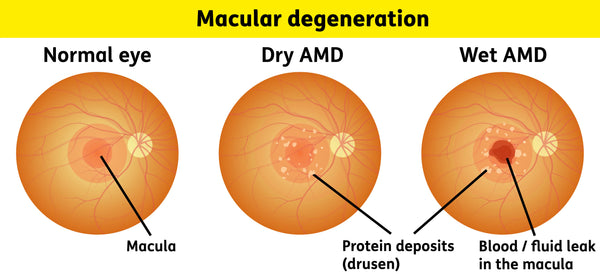
The macula is the small central portion of the retina responsible for sharp, detailed vision. Everything AMD does, it does there. That single fact explains the entire symptom pattern.
AMD affects the center of your visual field, not the edges. It does not cause pain, redness, discharge, or a "curtain" coming across your side vision. It does not cause total blindness. If you're experiencing those things, something else is going on and it still deserves prompt attention - just from a different angle.
Early Symptoms: Often None
In early AMD, the retina is accumulating deposits called drusen beneath its support layer, but enough functioning tissue remains that vision often measures 20/20. Many people are first told they have macular degeneration at a routine eye exam, having noticed nothing at all.
When the earliest symptoms do appear, they tend to be subtle and easy to dismiss as ordinary aging:
- Needing brighter light to read. Patients often describe turning on more lamps, or finding that restaurant menus in dim lighting have become impossible.
- Slow adaptation to dim light. Walking from bright sunlight into a dark theater, or from a lit room into a dark hallway, takes noticeably longer than it used to. This is one of the earliest measurable changes in AMD and often precedes any drop in visual acuity.
- Reduced contrast sensitivity. The world looks washed out or hazy. Faces are harder to distinguish across a room. Low-contrast tasks — reading light gray print, pouring coffee into a dark mug, spotting a curb of the same color as the sidewalk — become harder even when a standard eye chart still reads 20/20.
- Colors seeming less vivid. Less common, but some patients notice a subtle dulling.
None of these are emergencies, but they're worth mentioning to your eye doctor, because they're the symptoms that most often get chalked up to "just getting older."
Intermediate and Advanced Dry AMD
As dry AMD progresses and patches of retinal tissue are lost, symptoms become more definite:
- Blurred or fuzzy central vision. Print looks smudged. The center of what you're looking at lacks crispness even with your glasses on.
- A blurry or blank spot in the center of vision. In advanced dry AMD, atrophied patches of retina create genuine gaps. Because the brain fills in missing information, this may not appear as a black hole — more often it feels like letters dropping out of a word, or a face whose features seem missing when you look right at it.
- Difficulty recognizing faces. A hallmark symptom, and often the one patients find most distressing. Peripheral vision keeps you oriented in a room, but the detail needed to identify who's across it lives in the macula.
- Reading becoming slow and effortful. Losing your place, skipping words, or finding that you read the beginning of a line but not the middle.
- Trouble with faces on screens, small print, and detailed hobbies - sewing, model building, reading music, playing cards.
Advanced dry AMD develops gradually, typically over years. Patients often adapt so incrementally that they underestimate how much has changed.
Wet AMD: The Symptoms That Mean Call Today
Wet AMD occurs when abnormal blood vessels grow beneath the retina and leak fluid or blood. Because the retina is physically lifted and distorted by that fluid, the symptoms are different in character - and much more sudden.
Metamorphopsia - distortion - is the classic warning sign. Straight lines appear bent, wavy, or kinked. Door frames bow. The lines on a page of text ripple. Tile grout lines curve. This is the symptom most specific to wet AMD, and it can appear over days.
Other symptoms that should prompt an urgent call:
- A new dark or gray spot in central vision (a scotoma), particularly one that appeared suddenly.
- A sudden drop in central vision in one eye.
- Objects appearing smaller or larger than they should in one eye compared to the other - a distortion of scale that occurs when fluid changes the spacing of photoreceptor cells.
- A blank or missing patch when reading - words or parts of words dropping out.
The distinction that matters most is speed. Dry AMD changes over months and years. Wet AMD changes over days and weeks. Any sudden change in central vision, especially distortion, should be evaluated promptly - ideally within a few days. Anti-VEGF treatment works well, but it works best before scarring occurs, and scarring causes permanent loss.
The One-Eye Problem - and How to Solve It
Here is the single most important practical point in this article: you must check each eye separately.
AMD frequently affects one eye before the other. With both eyes open, the better eye covers for the worse one so effectively that substantial vision loss can go completely unnoticed. It's common for patients to discover advanced disease in one eye entirely by accident - rubbing the good eye, or having it examined.
The solution takes ten seconds a day. Cover one eye, look at something with straight lines - a window frame, a door, a tiled wall - and note whether the lines are straight and whether any spot is missing or blurred. Then switch eyes. An Amsler grid, a printed square grid with a dot in the center, is designed exactly for this and is free from your eye doctor's office. Wear your reading glasses, hold it at normal reading distance, stare at the center dot, and note any lines that wave, bend, or disappear.
Doing this daily gives you a personal baseline, which is what makes a new change obvious rather than ambiguous.
What AMD Does Not Cause
It's worth naming these, because patients often attribute unrelated symptoms to their AMD diagnosis:
- Pain, redness, or discharge - not AMD.
- Loss of peripheral vision - not AMD. Consider glaucoma or a retinal detachment.
- Sudden floaters or flashes of light - not AMD, and possibly a retinal tear. This warrants an urgent evaluation on its own.
- Complete blindness - AMD does not cause this. Even in advanced disease, peripheral vision remains, and patients retain the ability to move about independently.
The Bottom Line
Early AMD is usually silent, which is why routine dilated eye exams matter even when your vision feels fine. Gradual changes - dimmer, hazier, harder-to-read vision - deserve a scheduled appointment. Sudden changes, especially distortion of straight lines, deserve a phone call the same day.
Check each eye separately, know your own baseline, and don't wait to see whether a new symptom improves on its own. In wet AMD in particular, the difference between prompt treatment and delayed treatment is often the difference between preserved vision and permanent loss.
*This article is for general education and is not a substitute for a personal evaluation by an eye care professional. If you notice a sudden change in your vision, contact your eye doctor promptly.*