The macula is named for its color. Anatomists who first looked closely at the center of the retina saw a faint yellow spot and called it the macula lutea — Latin for "yellow spot." That yellow is not a trick of the light or a pigment the eye makes on its own. It is made of two plant compounds, lutein and zeaxanthin, that your body cannot manufacture and must get from food. Every molecule of macular pigment you have was, at some point, part of something you ate.
This matters because the yellow is doing a job. Macular pigment sits directly in the path of incoming light, in front of the photoreceptors responsible for reading, driving, and recognizing faces, and it functions as a built-in filter and antioxidant for the most hard-working few millimeters of tissue in the body. In the AREDS2 trial, lutein and zeaxanthin became part of the standard supplement formula for people with intermediate age-related macular degeneration (AMD). This post explains what these two compounds are, what they do in the retina, what the research actually showed, and how to get them.
What Lutein and Zeaxanthin Are
Lutein and zeaxanthin are carotenoids, the family of pigments that make carrots orange, tomatoes red, and marigolds yellow. Plants produce more than 600 different carotenoids, and around 40 to 50 of them show up in the human diet. Of those, roughly 20 make it into the bloodstream. Only two — lutein and zeaxanthin — are found in the macula in any meaningful quantity, along with a third, meso-zeaxanthin, that the retina appears to manufacture from lutein on site.
That selectivity is remarkable. The retina has specific binding proteins whose job is to pick lutein and zeaxanthin out of the blood, carry them into the macula, and hold them there. Concentrations in the center of the macula can be a thousand times higher than in the blood. The body does not go to that kind of trouble by accident.
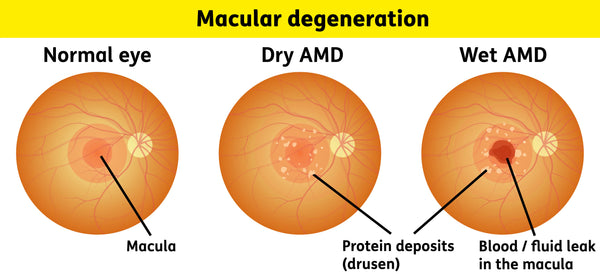
The two compounds are not distributed evenly. Zeaxanthin (and meso-zeaxanthin) dominate at the very center of the fovea, where the cone photoreceptors are packed most densely and visual acuity is highest. Lutein takes over toward the edges. Together they form a yellow disc roughly one to two millimeters across, which is exactly the region that AMD damages.
What Macular Pigment Does
Macular pigment has two well-established roles.
The first is optical. Lutein and zeaxanthin absorb light most strongly in the blue part of the spectrum, around 460 nanometers. Blue light is the highest-energy visible light that reaches the retina (ultraviolet is absorbed by the cornea and lens before it gets there), and it is the wavelength most capable of generating reactive oxygen molecules in retinal tissue. Because the pigment sits in front of the photoreceptors, it filters a portion of that blue light before it reaches the cells that would be damaged by it. Researchers estimate that a well-supplied macula can screen out 40 percent or more of incoming short-wavelength light. The pigment also reduces chromatic aberration and glare, which is one reason macular pigment density has been linked to contrast sensitivity and glare recovery in people with and without eye disease.
The second role is chemical. Lutein and zeaxanthin are potent antioxidants — molecules that neutralize the reactive oxygen species generated when light, oxygen, and the fatty membranes of photoreceptors meet. The outer segments of photoreceptors are extremely rich in polyunsaturated fatty acids, which are precisely the fats most vulnerable to oxidation. The retina consumes more oxygen per gram than any other tissue and is illuminated all day. It is, in short, the ideal environment for oxidative damage, and macular pigment is one of the retina's primary defenses against it.
There is a third role that is less settled but actively studied: lutein and zeaxanthin appear to have anti-inflammatory effects and may stabilize cell membranes. Chronic low-grade inflammation is now understood to be central to AMD, and this remains an area of ongoing research.
Measuring the Pigment: Macular Pigment Optical Density
Because the pigment is yellow and sits in a predictable location, it can be measured. The most common measurement is called macular pigment optical density, or MPOD. Several techniques exist, but the one most patients encounter is heterochromatic flicker photometry, a painless test in which you look at a flickering light and adjust it until the flicker disappears. The measurement takes a few minutes and produces a single number, typically between 0 and 1, that reflects how much pigment is present.
MPOD varies enormously between people. Some of that variation is genetic, but a large share of it is dietary. People who eat more lutein- and zeaxanthin-rich foods have measurably higher MPOD, and supplementation raises MPOD in most people within a few months. Lower MPOD has been associated with higher AMD risk in multiple studies, though whether low pigment causes AMD or is simply a marker of the same underlying factors is still debated.
Not every eye care office measures MPOD, and it is not yet part of standard AMD care. But if your doctor offers it, the number gives you a concrete way to see whether your diet or supplement routine is changing something in your eye.
What the Research Showed
The reason lutein and zeaxanthin are in every AREDS2-based formula on the market comes down to the AREDS2 trial itself, and it is worth being precise about what that trial found, because the headline is more nuanced than "lutein works."
AREDS2 enrolled 4,203 people with intermediate AMD (or advanced AMD in one eye) and followed them for five years. Participants were randomized to receive the original AREDS formula with or without 10 milligrams of lutein and 2 milligrams of zeaxanthin added. The primary analysis found that adding lutein and zeaxanthin on top of the original formula produced a reduction in progression to advanced AMD that did not reach statistical significance — a roughly 10 percent lower risk.
The secondary analyses are where the picture sharpened. When the researchers compared people who got lutein and zeaxanthin instead of beta-carotene to people who got beta-carotene, the lutein/zeaxanthin group had an 18 percent lower risk of progressing to advanced AMD. And when they looked at participants whose diets were lowest in lutein and zeaxanthin to begin with, adding the supplement reduced progression by about 26 percent. In other words, the people who benefited most were the people who had the least to start with.
There was also a finding in the wrong direction for the comparison compound. Beta-carotene, which had been part of the original AREDS formula, was associated with an increase in lung cancer among former smokers in AREDS2, echoing earlier trials. That, combined with the retinal data, is why lutein and zeaxanthin replaced it in the current formula.
Follow-up analyses published in the years since have continued to support the substitution. A 10-year follow-up of AREDS2 participants found that the lutein/zeaxanthin formula reduced progression to advanced AMD by about 20 percent compared with the beta-carotene formula, with no increase in lung cancer risk.
What AREDS2 did not show is equally important. It did not study people with healthy eyes or early AMD, so it says nothing about preventing AMD from ever developing. And it did not test lutein and zeaxanthin alone; they were always part of a formula that also included vitamin C, vitamin E, zinc, and copper. The evidence supports lutein and zeaxanthin as part of that specific formula, for people at the intermediate stage, to reduce the chance of progression.
Where the Pigment Comes From: Food Sources
Most Americans consume about one to two milligrams of lutein and zeaxanthin per day. The AREDS2 dose is 12 milligrams, and the diets associated with the lowest AMD risk in observational studies tend to deliver something in the range of six milligrams or more. The gap between typical intake and protective intake is large, and it is mostly a vegetable gap.
Dark leafy greens are the richest source by a wide margin. A cup of cooked kale contains roughly 20 milligrams of lutein and zeaxanthin; cooked spinach is similar. Collard greens, Swiss chard, turnip greens, and mustard greens are all in the same league. Cooking does not destroy these carotenoids and actually makes them easier to absorb by breaking down the plant cell walls that hold them.
Zeaxanthin specifically is harder to come by, because most greens are heavily weighted toward lutein. The best zeaxanthin sources are orange bell peppers, sweet corn, goji berries, and orange-fleshed squash. Egg yolks deserve special mention: they contain relatively small amounts of both compounds, less than a milligram per egg, but the fat in the yolk makes those carotenoids exceptionally well absorbed. Studies have shown that adding an egg a day raises blood lutein and zeaxanthin levels more than the raw numbers would predict.
That points to a general rule. Lutein and zeaxanthin are fat-soluble. Eating them with fat — olive oil on your greens, avocado in your salad, the yolk with the white — can double or triple absorption compared with eating them plain. A fat-free salad is a less effective salad, at least for the macula.
Broccoli, peas, Brussels sprouts, romaine lettuce, and pistachios contribute meaningful amounts as well. Fruits are generally modest sources, though kiwi, grapes, and oranges add a little. Desert truffles, the fungus at the center of TruVista's formulation, are also a natural source of carotenoids, which is one of the reasons they drew our interest in the first place.
Supplement or Salad?
For someone with healthy eyes, the honest answer is that food comes first. A diet built around a daily serving of dark leafy greens, cooked with a little fat, gets most people into the range that observational studies associate with lower risk, and it brings along fiber, folate, vitamin K, and everything else that comes with vegetables and not with capsules.
For someone with intermediate AMD, the answer changes. AREDS2 tested a specific dose, in a specific formula, in a specific population, and found a benefit. Eating your way to 12 milligrams a day of lutein and zeaxanthin is possible but requires real consistency — and the rest of the AREDS2 formula, particularly the 80 milligrams of zinc, cannot be reached through food at all. That is why eye doctors recommend the formula rather than a diet plan for patients at that stage, and why the formula is not recommended for people who have not reached it.
The two approaches are not in competition. The AREDS2 participants who benefited most from supplementation were those with the poorest diets, which suggests the supplement was, in part, filling a nutritional hole. Filling that hole with food as well only helps.
The Takeaway
Your macula is yellow because of two compounds you ate, and it holds onto them because they protect it. Lutein and zeaxanthin filter the most damaging wavelengths of visible light before they reach your photoreceptors and neutralize the oxidative byproducts of vision itself. For people with intermediate AMD, they are part of the only nutritional formula shown in a large randomized trial to slow progression. For everyone else, they are one more reason to eat your greens — with a drizzle of olive oil.
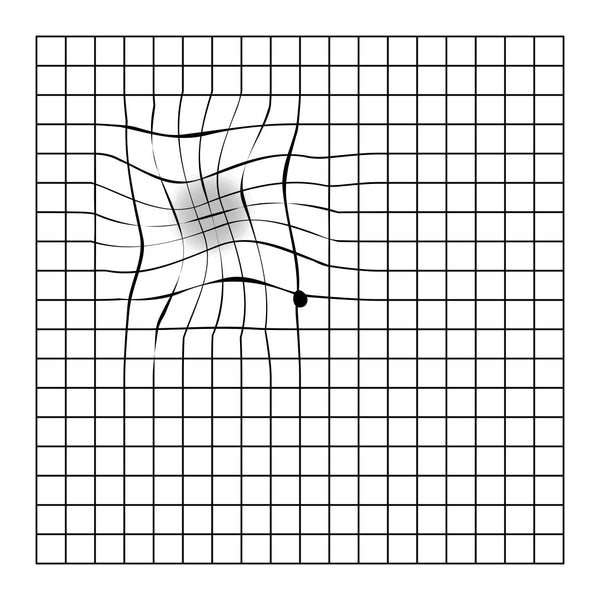
If you have been told you have drusen or intermediate AMD, ask your eye doctor whether an AREDS2-based supplement is appropriate for you. If you are not sure where you stand, the Amsler grid is a good place to start, and our guide to AREDS2 explains who the formula is for.
TruVista Plus AREDS2 contains the full AREDS2 formula, including 10 mg lutein and 2 mg zeaxanthin, combined with 500 mg of desert truffle extract in a beta-carotene-free formulation.
This article is for informational purposes only and is not a substitute for medical advice. Consult an eye care professional before starting or changing any supplement regimen.
These statements have not been evaluated by the Food and Drug Administration. This product is not intended to diagnose, treat, cure, or prevent any disease. Dr. Tarabishy's role is as formulator of TruVista dietary supplements. Nothing on this page constitutes medical advice or a physician-patient relationship.